Author: Eddie Coleman
-

1,885 Announced Jobs in Wilson County, and 411 Housing Permits
Johnson & Johnson will build a second manufacturing facility in Wilson County, adding up to 500 jobs to the 420 it committed in October 2024. That makes five large manufacturing announcements in the county since March 2024, 1,885 jobs between them. Wilson authorized 411 new private housing units by building permit last year, down from…
-

How a Steel Plant Reshapes Hertford County’s Housing Demand
A corner of the state that rarely draws big private capital just landed a second major steel employer. US Forged Rings will build a specialty steel plant in Cofield, in rural Hertford County, pledging up to $875 million and 625 jobs, according to the North Carolina Governor’s office. Those jobs are the input. Workforce housing…
-

What It Means for Real Estate When NC Builds the Glass That Powers AI
The AI buildout runs on glass fiber, and North Carolina makes most of America’s supply. In May, NVIDIA committed up to $3.2 billion to expand Corning’s U.S. manufacturing, part of a wave of advanced-manufacturing investment landing in Catawba County’s fiber corridor. The data centers grab the headlines, but the durable real-estate story is the workforce…
-

Amazon and Corning Bring 1,000 Manufacturing Jobs to North Carolina
Amazon and Corning have struck a multibillion-dollar agreement to make the fiber-optic cable that runs Amazon’s data centers — and it’s adding 1,000 advanced manufacturing jobs at Corning’s North Carolina plants, most of them around Hickory. For real estate investors, the story isn’t the cable. It’s where 1,000 new workers will live, and what steady…
-

Siemens Adds 350 Jobs in Raleigh and Wendell to Power AI Data Centers
Siemens is investing more than $165 million across the Carolinas to manufacture the electrical hardware behind AI — and 350 of the new jobs land in Wake County, split between Raleigh and the fast-growing town of Wendell. The headline is the jobs. The part worth watching for real estate investors is what durable, high-skill payroll…
-

Morinaga’s $136M Mebane Plant and What 204 Manufacturing Jobs Mean for Orange County
Morinaga, the Japanese maker of HI-CHEW candy, has opened its second factory in Mebane, a $136 million investment creating 204 jobs in Orange County and roughly doubling its U.S. production capacity. The plant goes fully operational by October 2026. For real estate investors, the story isn’t the candy, it’s what a second decade of steady…
-
North Carolina’s Corporate Tax Just Dropped to 2%
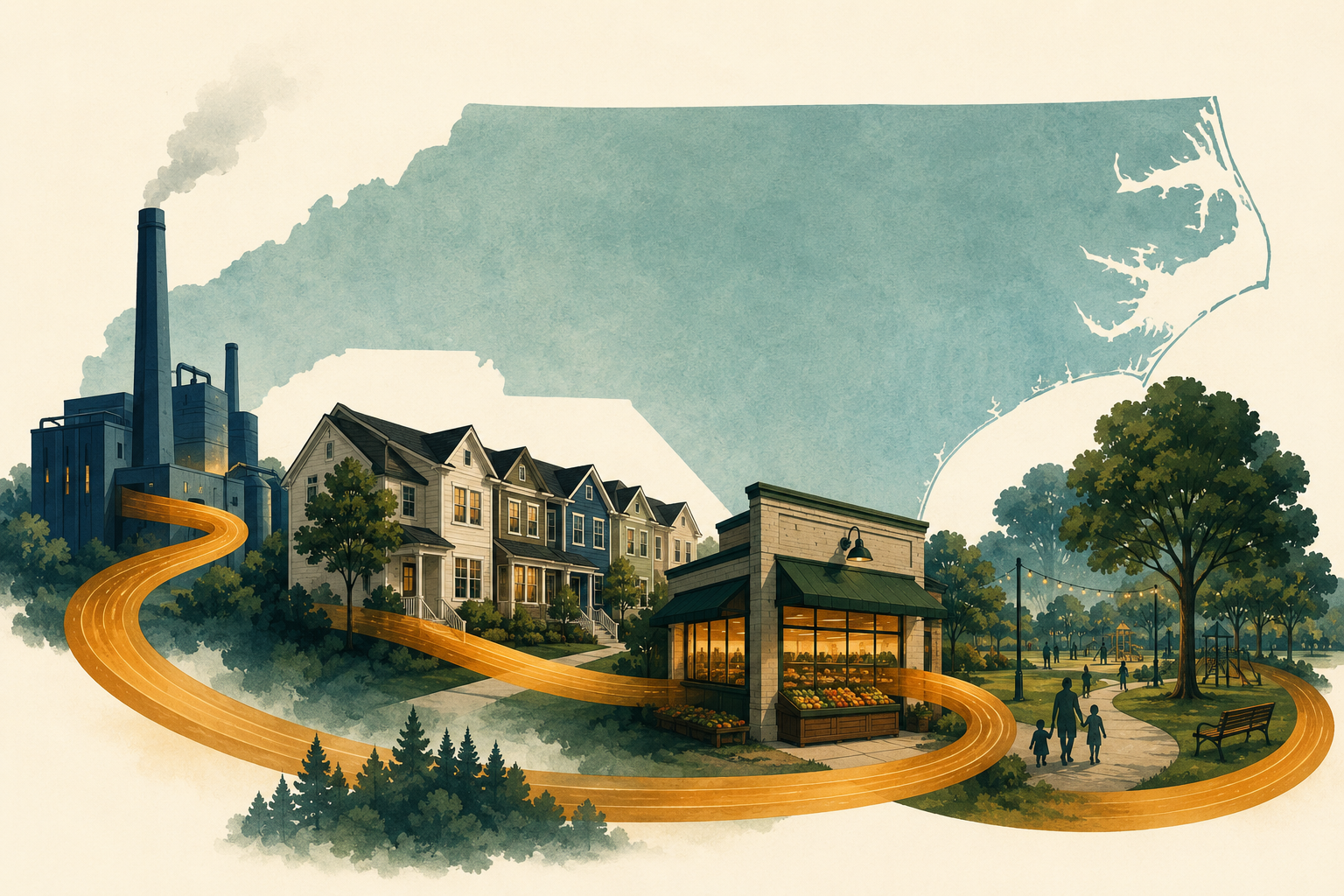
On January 1, 2026, North Carolina’s corporate income tax dropped from 2.25% to 2.0% — the next step in a statutory phase-out scheduled to reach 0% by 2030. The rate is real. The path is contested. Here’s why the recruiting machine the rate keeps feeding matters more for NC housing and retail demand than the…
-

NC Just Put $2.6M into Kingsboro’s Water — Here’s Why It’s a Leading Indicator
The Economic Development Partnership of North Carolina (EDPNC) has awarded Edgecombe County $2,637,650 through its Megasite Readiness Program to upgrade public water service to the 1,449-acre Kingsboro Business Park between Rocky Mount and Tarboro. The grant keeps one of NC’s most shovel-ready industrial sites infrastructure-current as state and regional recruiters work to land its next…
-

How Tenants Build Your Equity: Loan Pay down as a Source of Real Estate Returns
Of the several ways real estate generates returns for investors, loan paydown is perhaps the least talked about — and one of the most reliable. It doesn’t make headlines, it doesn’t depend on market conditions, and it works quietly in the background every time a mortgage payment is made. Here’s how it works. What Is…
-

Real Estate as an Estate Planning Tool: What LP Investors Should Know
Most conversations about passive real estate investing focus on returns during your lifetime — cash flow, appreciation, tax efficiency. Those are compelling reasons to invest. But real estate also has characteristics that make it a useful component of estate planning, and for investors thinking about legacy and wealth transfer, it’s worth understanding how LP interests…