On January 1, 2026, North Carolina’s corporate income tax stepped from 2.25% to 2.0% — the next move in a six-year phase-out set to reach 0% by 2030.
After forty years of watching capital decide where to put down roots in this state, I can tell you the rate gets you into the room. What North Carolina has built behind the rate is what closes the deal. And what closes the deal eventually shows up in our markets as workforce-housing demand, retail leases, and durable returns.
What Changed and What’s on the Books
The phase-out came out of Session Law 2021-180 — the 2021 budget compromise that wrote the corporate rate down from 2.5% to 0% across six tax years.
The schedule:
- TY 2024: 2.5%
- TY 2025: 2.25%
- TY 2026: 2.0% — we are here
- TY 2027: 2.0% (no scheduled change)
- TY 2028: 1.0%
- TY 2029: 1.0% (no scheduled change)
- TY 2030 forward: 0%
The cuts are written into law. They are also politically contested — more on that below.
Among states that still tax corporate income, NC’s 2% flat rate is the lowest in the country. The next-lowest peers sit at 4.0–4.4%. The southeastern competitive set runs higher: Georgia 5.39%, South Carolina 5.0%, Florida 5.5%, Tennessee 6.5%. NC is alone at the bottom.
A Low Rate Is a Magnet, Not a Trophy
The rate matters. It has never been the thing.
When a battery OEM or aerospace site team is choosing among three states for a multi-billion-dollar project, the comparison spreadsheet has thirty rows on it: workforce, transportation, utility load, permitting clock, land cost, climate risk, tax rate, incentives. The rate is one row.
What the rate does is get NC into the room. Once you’re in, the other rows have to do their work — and over the last two decades North Carolina has built every other row to compete.
The infrastructure behind the rate:
- EDPNC — the Economic Development Partnership of North Carolina, the state’s lead recruiter, full-funnel from first inquiry to ribbon cutting
- JDIG — the Job Development Investment Grant, which on a major project returns up to 90% of state withholdings to the company over 30 years
- Megasite portfolio — Greensboro–Randolph (Toyota), Chatham Park, Person County, Anson CSX, Kingsboro — multi-thousand-acre tracts already permitted and utility-ready
- NCCCS — the community college system, 58 colleges training a workforce that can be tailored to a single employer when needed
The rate gets the call. The stack closes the deal.
The Catches Speak for Themselves
NC didn’t talk its way to the top of the rankings. NC won deals.
A short list from the last five years:
- Toyota — $14B EV battery plant in Liberty (Randolph County), 5,100 jobs at full ramp
- Eli Lilly — Concord, $1B+ injectables manufacturing
- Boom Supersonic — Overture Superfactory at PTI, 2,400+ jobs by 2032
- Honda Aircraft — HondaJet campus at PTI, ~1,100 jobs
- Google Cloud — Durham hub, 1,000+ jobs targeted
- Lumentum — 400+ advanced manufacturing jobs at a Greensboro AI-laser fab, production 2028 (announced March 2026)
That’s not a tax rate doing the heavy lifting. That’s a tax rate plus everything else.
Site Selection’s Prosperity Cup ranked NC #1 nationally 2021–2023 and #2 in 2025. Area Development’s 2025 Top States for Business put NC #5 overall and #4 on permitting speed.
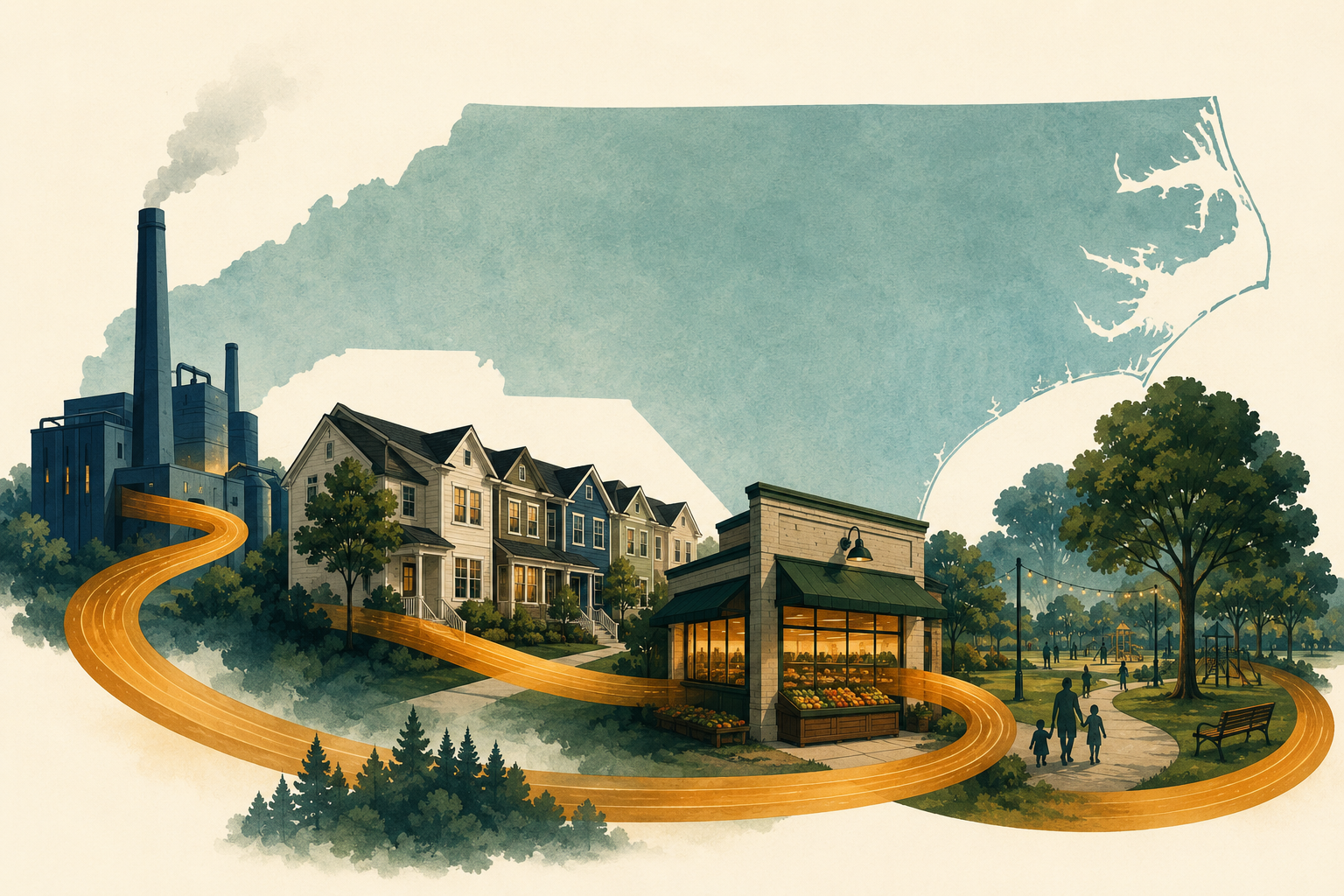
How a Tax Rate Becomes a Housing and Retail Cycle
This is where the rate stops being a tax-policy story and becomes a real estate story.
The chain runs the same way every time:
- The rate + EDPNC + JDIG + megasites get NC into the final round of a site search
- Jobs get announced — multi-year construction and ramp; hiring starts before the building is done
- Workers move in — most rent first, even if they own at the prior address
- Multifamily absorption rises within a 30–45 minute commute shed of the new employer
- Daily-needs retail follows the rooftops — grocery, medical, fitness, restaurants, child care
- Workforce-housing rents and neighborhood retail leases firm up. Investor returns firm up.
The Triad is running this cycle now around Toyota, Boom, Honda, and Lumentum. The Triangle has been running it for decades around RTP and is running it again around its current tech and pharma anchors. Charlotte is running it around banking, healthcare, and Eli Lilly.
NC’s net domestic in-migration runs at +7.5 per 1,000 residents per the most recent Census Bureau release — #1 nationally in absolute terms, top three per capita. That’s the chain working.
The Honest Caveat: The Ramp May Slow
I have to be straight with you.
The 2.0% rate is in effect right now. The 1.0% step in 2028 and the 0% rate in 2030 are written into law but politically contested.
What’s in motion:
- SB 233 and HB 303 — companion bills filed in the 2025 session to repeal the phase-out outright. Filed; have not advanced.
- Governor Stein’s April 2026 budget proposal — calls for pausing the corporate and individual rate cuts. Not enacted.
- Senate (GOP) leadership — has called pausing the cuts a “nonstarter.”
- House — more cautious, weighing a projected $3.5–$5B revenue gap if cuts phase in as scheduled.
A few things to keep in mind. Slowing or repealing the cuts requires affirmative action by the legislature, which has so far failed to clear committee. Even if the phase-out is paused at 2.0%, NC remains alone at the bottom of the national table. And the budget pressure is real — expect this fight to recur every cycle through 2030.
The way to underwrite this is the way I’ve underwritten every other multi-year tailwind: assume the floor, hope for the trajectory. The floor is 2.0%, already best-in-class. The trajectory to 0% is a bonus — not the thesis.
The Operator’s Read
Investors who underwrote North Carolina five years ago are sitting on positions that benefited from the migration, the job growth, the absorption, and the rent growth this chain helped catalyze. The same chain is set up to run through the rest of the decade.
What the 2.0% rate signals — separate from whether it ever reaches 0% — is that NC’s political establishment has done the work to keep the recruiting flywheel turning. They built EDPNC. They funded JDIG. They assembled the megasites. They told site selectors NC intends to keep cost of operation low and predictability high. That signal doesn’t get unsigned overnight.
For investors looking for steady cash flow, capital preservation, and anchor-employer durability across multifamily and daily-needs retail, the rate matters less than what the rate confirms: North Carolina is doing the work to keep this state in the running.
There’s no bad real estate, just bad timing. NC is doing the work to keep the timing on our side for the next decade.

Eddie Coleman, CCIM, is the Principal Investment Officer at NC Capital Group. With over 40 years of experience in Commercial Real Estate in North Carolina and South Carolina, his experience spans multifamily, retail, office, historic adaptation, etc. In addition to advising clients and brokering transactions, he has extensive knowledge of North Carolina through experience in corporate site acquisition, development, capitalization, HUD financing, etc. He holds the prestigious Certified Commercial Investment Member (CCIM) designation.