
The state’s innovation report shows population growth concentrated in the metro cores and household income rising toward the U.S. average. We read those numbers as pointing to a need for housing within commuting distance of the metros.
Summary in one minute
- North Carolina’s population grew 39.2% from 2000 to 2025, the 8th fastest rate in the country. Most of that growth is in a small number of counties, led by Wake and Mecklenburg.
- Median household income is 91% of the U.S. average. Since 2005, it has grown faster than the U.S. average.
- Incomes are highest in the metro cores, meaning the large counties at the center of the state’s metro areas, such as Wake, Mecklenburg and Durham.
- Our reading of those numbers: the households that fill jobs in the metro cores need housing within commuting distance. That puts the demand in the communities around each metro, which we call the halo.
- We are optimistic about North Carolina real estate for the long run. The state is making progress, it focuses on innovation, and it measures its progress against the other states.
The N.C. Department of Commerce publishes Tracking Innovation every few years. The report ranks North Carolina against the other 49 states on 41 measures the state chose as the ones that matter for its economy. The tenth edition came out on September 10, 2026. North Carolina ranked 9th on the report’s combined innovation score, its first time in the top 10.
The report publishes every ranking, including the measures where North Carolina trails other states. Most of the measures come from federal sources, such as the U.S. Census Bureau and the U.S. Bureau of Economic Analysis, and each measure uses the same data for every state.
Two of those measures matter most to a real estate investor: population growth and income.
Growth is concentrated in the metro cores
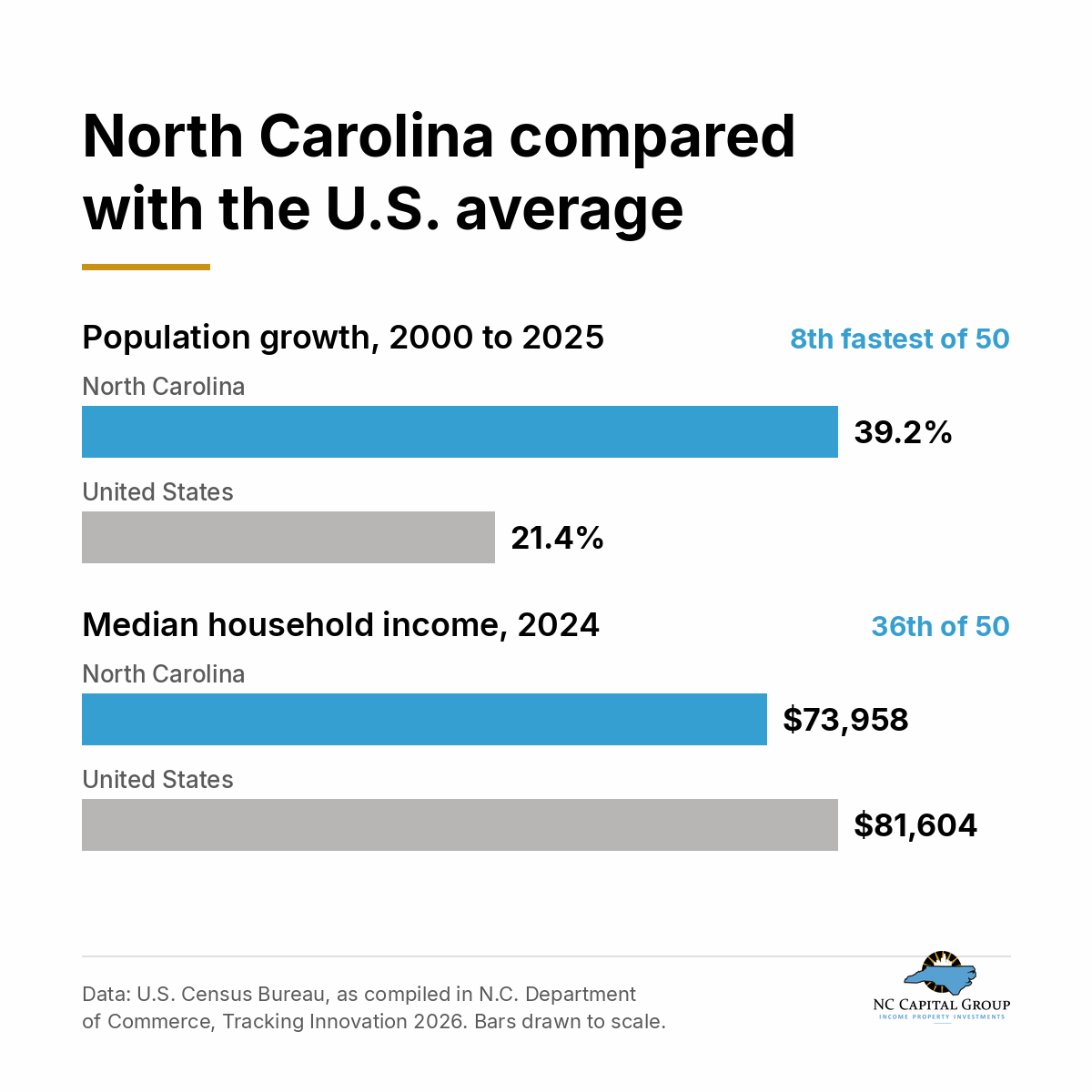
From 2000 to 2025, North Carolina’s population grew 39.2%, compared with 21.4% for the U.S. average. That makes North Carolina the 8th fastest-growing state. Over the same period, it moved from the 11th most populous state to the 9th.
Most of that growth is in a small number of counties. Wake and Mecklenburg counties account for 37.1% of it. Eleven of the state’s 100 counties account for 70%.
For the longer view of where the population is headed, see 11.7 Million by 2030: What NC’s Population Curve Means for Real Estate Investors.
Incomes are rising, and highest in the metro cores
Median household income is the income of the household in the middle: half of households earn more and half earn less. North Carolina’s is $73,958. That is 91% of the U.S. average of $81,604 and ranks 36th among the 50 states. Three related measures are also close to 90% of the U.S. average. Per capita means per resident.
- Per capita income: 34th, at 90% of the U.S. average
- Per capita gross domestic product (GDP), the value of the economy’s output per resident: 31st, at 88%
- Average annual wage: 21st, at 91%
Incomes here are rising faster than the U.S. average. Adjusted for inflation, North Carolina’s median household income grew 13.1% from 2005 to 2024, compared with 9.9% for the U.S. average. Average wages, also adjusted for inflation, have grown faster than the U.S. average.
Incomes are highest in the metro cores. Four counties have an average wage above the state average: Durham, Mecklenburg, Wake and Orange. Wake County has the highest median household income in the state, at $105,768.
Living costs are lower here. North Carolina’s cost of living index was 95.5 in 2025, where the U.S. average is 100. That makes it the 12th most affordable state. A lower cost of living makes a job here more attractive to someone deciding whether to move.
Where the housing is needed
The report does not discuss housing. It measures growth and income. What follows is our reading of its numbers.
The growth and the highest wages are concentrated in the metro cores. Those economies also depend on nurses, teachers, technicians and service workers. Those households need housing they can afford within commuting distance of their jobs. That puts the demand in the communities around each metro, the halo around Charlotte, Raleigh-Durham and Winston-Salem/Greensboro.
The demand is for workforce housing, meaning apartments and homes priced for households earning around the local median household income. It is also for daily-needs retail, meaning grocery stores, pharmacies, daycare and similar businesses people use every week.
Underwriting a property means evaluating it as an operating business whose main source of revenue is rent. Rent depends on the market: the supply of housing and the demand for it. When we underwrite, we don’t add future demand that doesn’t exist right now. We do select locations where that demand is likely to happen.
Why North Carolina, for the long run
We are optimistic about North Carolina real estate for the long run. We like that the state focuses on innovation, and that it measures its progress against the other states and publishes the results. We see these as supporting jobs, people moving to the state, and in turn, future demand for housing and daily-needs retail.
A property stays where it is for the whole time you own it, so the direction of the state affects the property’s value over that time.
Innovation attracts capital investment, and capital investment creates jobs. The economic development announcements we write about are examples of this.
Good government doesn’t guarantee a good investment. The rents, the costs, and the debt still have to work. However, good government creates a stable, promising environment for real estate to prosper.
Sources:
- N.C. Department of Commerce: Tracking Innovation 2026, the N.C. Innovation Index. Figure i (statewide summary); Indicator 1.1 (gross domestic product); Indicator 1.2 (income); Indicator 1.3 (average annual wage); Indicator 1.6 (population growth); Indicator 6.3 (cost of living). The report draws on the U.S. Census Bureau, the U.S. Bureau of Economic Analysis, the U.S. Bureau of Labor Statistics and the Council for Community and Economic Research.
- N.C. Department of Commerce: North Carolina breaks into top 10 states for innovation (press release, September 10, 2026)
- NC Capital Group: 11.7 Million by 2030, What NC’s Population Curve Means for Real Estate Investors

Doug Kline, PhD, has held income properties in North Carolina for more than 20 years. He holds a North Carolina broker’s license, and is a member of the National Association of Realtors and the Triangle Real Estate Investors Association. He holds an MBA and a PhD in business. In addition to his real estate activities, Doug enjoyed a successful career in academia, achieving the rank of Full Professor in the Cameron School of Business at UNC Wilmington. He was honored with research and teaching awards, served as Director of the MS Computer Science and Information Systems program, and was awarded the endowed position Distinguished Professor of Information Systems.