
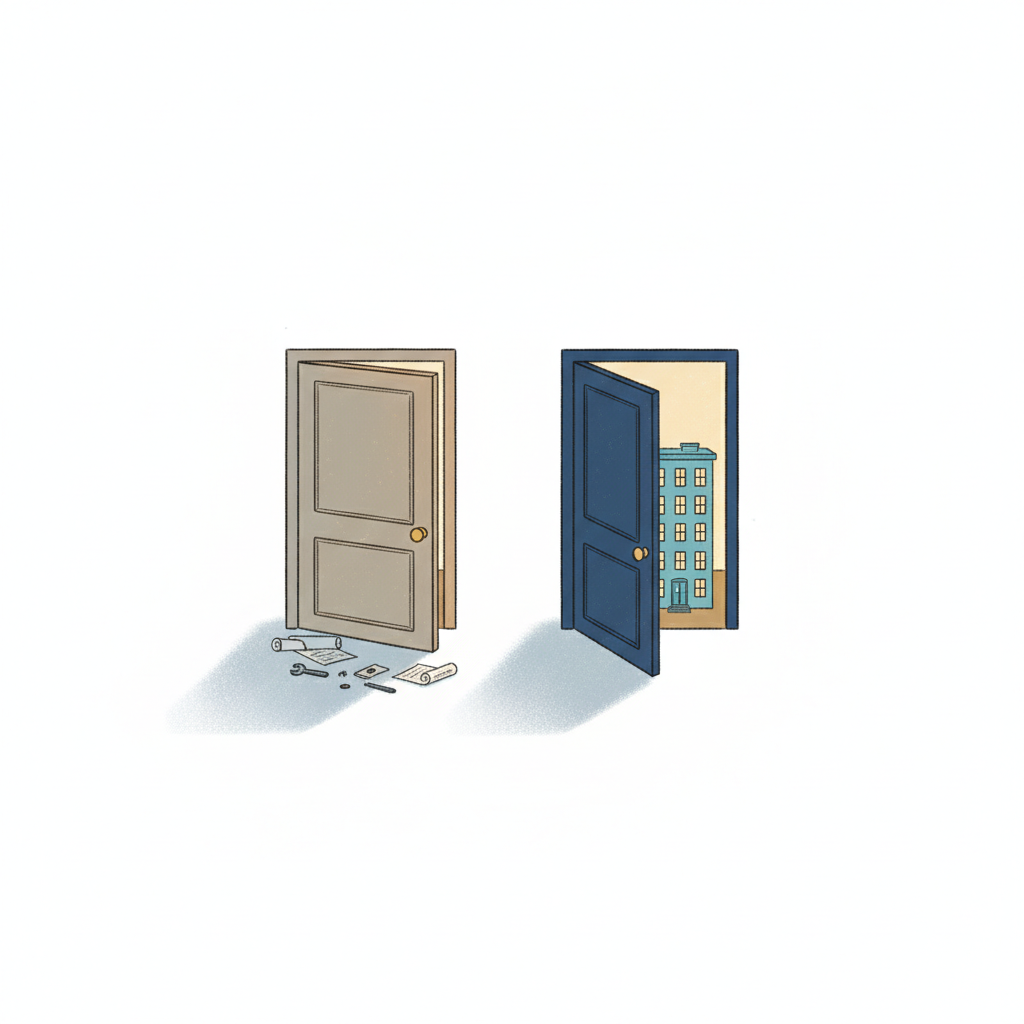
You Researched Real Estate Investing and Realized It’s a Second Job. Here’s the Other Door.
You did the homework on becoming a landlord. The numbers worked; the lifestyle didn’t. There’s another way to own real estate that doesn’t ask for your evenings.
Summary in one minute
Most people who research becoming a landlord conclude it’s a second job, and they’re right. But you can still own real estate without managing it, as a limited partner in a syndication or fund. You give up management control and liquidity; you keep your time, cash flow, appreciation, and tax treatment.
The case for real estate is straightforward: cash flow, appreciation, tax advantages, and diversification through a real, physical asset you can actually touch.
The other half: tenant screening, the 2 a.m. plumbing call, property managers who take a cut and still need managing, vacancy, evictions. The “passive income” promise looks a lot like a second job on top of the one you already have.
Real estate investing isn’t the problem. The second job is. This article lays out another option.
What your research told you
Real estate is a serious wealth-building asset. Being a hands-on landlord is real work. Both are true at once. Can you own the asset without running it?
The U.S. Census Bureau’s Rental Housing Finance Survey, the most comprehensive look at who actually owns America’s rental housing, shows a large share of rental properties are held by individual investors, not big institutions. A lot of regular professionals have tried the do-it-yourself route. Many do fine. Plenty conclude that managing property is a job they didn’t want.
The real question is “active or passive?”
Quick recap
- Real estate is a real wealth-building asset
- Landlording is real, ongoing work
- The real question is active or passive
The second door: ownership without operation
You can own a piece of real estate the same way you own a piece of a company through your brokerage account: you buy shares in a company that buys and operates a property, you share in the returns, and someone else runs the day-to-day.
In real estate, that structure is usually a syndication or a fund. A group of experienced operators (the general partners) acquires and manages a property, creating a business centered on the property. Investors like you (the limited partners) contribute capital and own a share of the business. You receive your portion of the cash flow and any gains over the life of the investment. You never get the 2 a.m. call. You’re an owner, not a manager.
And unlike a share of a fund, what you own is tangible and specific: a real building you can drive past, with operators you can pick up the phone and question. That kind of visibility is something most paper investments can’t offer.
If the mechanics are new to you, start with our foundational explainer: Passive Real Estate Investing Explained: LP Ownership, Cash Flow, and Exit. It walks through ownership, income, and how an investment wraps up, in plain language.
Quick recap
- LPs and GPs both own it; the GPs also operate it
- LPs (you) get cash flow and gains
- No 2 a.m. plumbing calls
- Tangible and transparent: drive past it, call the operators
Being honest about the trade-offs
Passive ownership means giving up day-to-day control. In exchange, the property is run by people who do this for a living: finding and buying the right asset, financing it, operating it, and selling it at the right time. Real estate returns come from doing that work well, and doing it well is a full-time profession. Unless you’re an expert operator yourself, the returns usually come from having one run the property, not from doing it yourself.
Passive real estate is also not liquid: your capital is typically committed for years, not days, and you can’t sell a limited-partner interest the way you’d sell a stock. It’s not a shortcut to wealth and it’s not risk-free. Markets move, business plans meet reality, and good operators plan for both.
For most busy professionals, that lock-up is a feature, not a drawback. It works like turning off the notifications on your phone: when you can’t sell on a whim or react to every market headline, you stop trying to. Your capital stays committed and does its job, the fundamentals get years to work, and your attention goes back where it belongs, to your family, your friends, and the career you’ve actually built. Go in clear-eyed about what you’re trading and what you’re keeping.
Quick recap
- Experts run the business. You give up day-to-day control
- Capital is locked up for years, by design, so you can focus elsewhere
- GP selection matters
Who this path tends to fit
Passive real estate tends to suit people who:
- Have money to invest but not hours to spare. They want the benefits of owning real estate, not the responsibilities.
- Think in years, not quarters. They’re building long-term wealth, not chasing a quick flip.
- Value transparency. A syndication is a specific building you can drive past and size up for yourself, run by operators you can actually call and ask questions. That’s a level of transparency most paper investments don’t offer.
If that list describes you, passive ownership is worth understanding in detail. If you actually want to swing a hammer and screen tenants, being a hands-on landlord may be a good fit.
Quick recap
- Dollars, yes; spare hours, no
- Long-term thinkers, not flippers
- Want to see what they own, not operate it
Where to start
This article is educational, not personalized advice; before you act on any of it, talk through your own situation with your financial, tax, or legal advisor, who can see the full picture you’re working with.
When you want the whole picture in one place, download our free guide, Practical Guide to Wealth Building through Passive Real Estate Investing. It lays out the passive route end to end.
Quick recap
- Get educated before you commit
- Loop in your own advisor
- Want the whole picture? Get the guide
What to do next
- Go deeper on the basics: read Passive Real Estate Investing Explained: LP Ownership, Cash Flow, and Exit for how LP ownership, cash flow, and the exit actually work.
- Talk it through with your team: bring this to your financial, tax, or legal advisor and ask how passive LP ownership fits your portfolio and tax picture.
- Get the full picture: download the Practical Guide to Wealth Building through Passive Real Estate Investing for the passive route end to end.
Sources:
- U.S. Census Bureau, Rental Housing Finance Survey (RHFS), comprehensive data on the ownership of U.S. rental housing (2024 data released February 2026).

Doug Kline, PhD, has held income properties in North Carolina for more than 20 years. He holds a North Carolina broker’s license, and is a member of the National Association of Realtors and the Triangle Real Estate Investors Association. He holds an MBA and a PhD in business. In addition to his real estate activities, Doug enjoyed a successful career in academia, achieving the rank of Full Professor in the Cameron School of Business at UNC Wilmington. He was honored with research and teaching awards, served as Director of the MS Computer Science and Information Systems program, and was awarded the endowed position Distinguished Professor of Information Systems.