
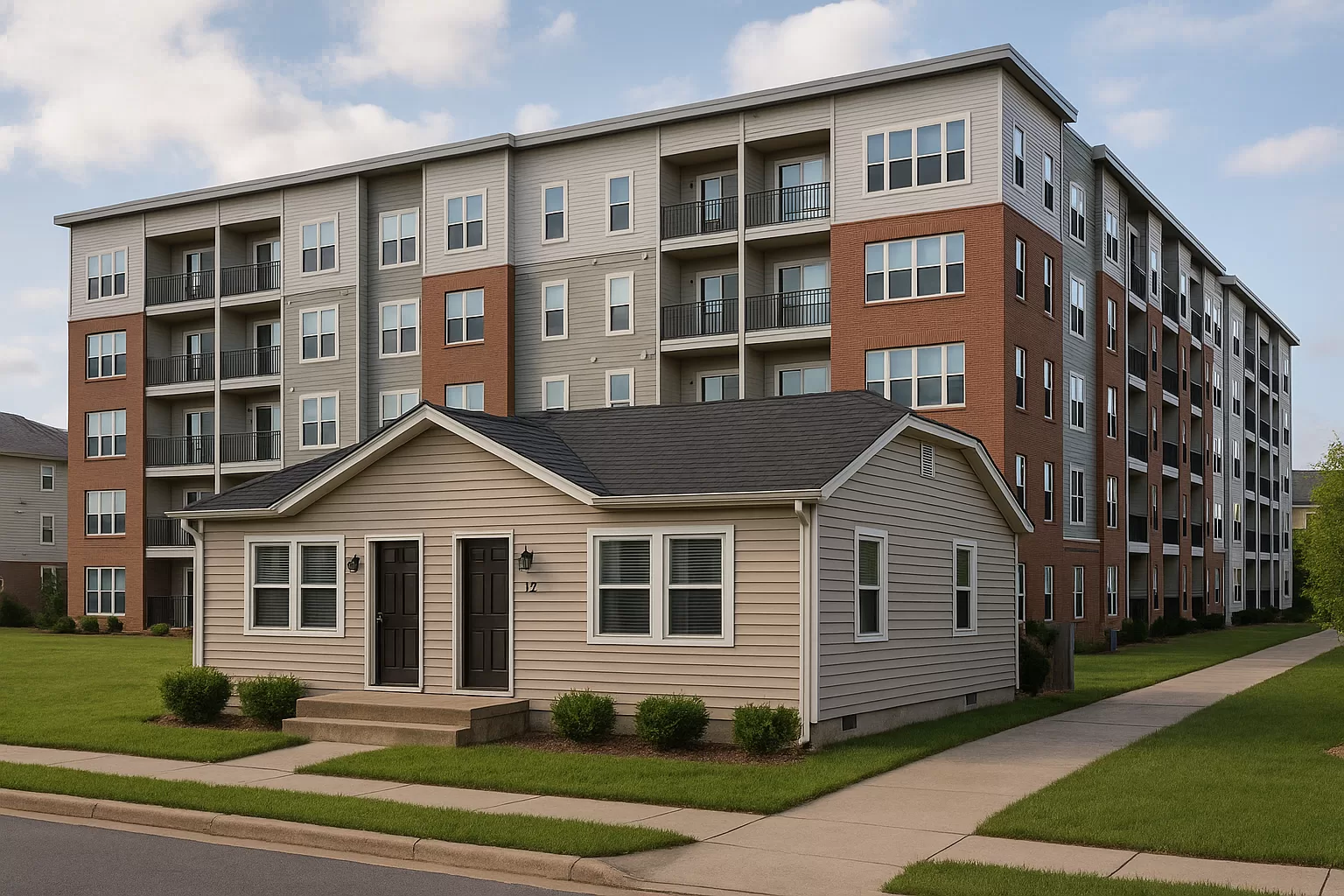
Investing $50,000 in real estate can open doors to wealth-building, but the vehicle you choose matters. A duplex purchase and a real estate syndication offer distinct paths, each with merits. However, syndication often emerges as the superior choice for investors seeking diversification, passive income, and scalability. Let’s compare the two and highlight why syndication stands out.
Investing $50,000 in a Duplex
A duplex, a property with two rentable units, is a tangible asset that can generate rental income and appreciate over time. With $50,000, you might use it as a down payment (typically 20-25%) for a $200,000-$250,000 duplex, financing the rest with a mortgage. Benefits include direct control, potential tax advantages (like depreciation), appreciation. and the ability to live in one unit while renting the other. However, challenges abound:
• High Management Burden: You’re responsible for tenant issues, maintenance, and repairs, which can be time-intensive and costly.
• Limited Diversification: Your investment is tied to one property in one market, exposing you to localized risks like vacancy or market downturns. With only two rentable units, losing a tenant means cutting rents in half, but debt service, insurance, and taxes remain the same.
• Capital Constraints: Additional costs (closing fees, renovations, or unexpected repairs) can strain your budget, and scaling to more properties requires significant new capital.
• Active Involvement: Even with a property manager, oversight is necessary, making it less passive.
Assuming a 6% cap rate, a $200,000 duplex might yield $12,000 annually before expenses. After mortgage payments, taxes, insurance, and maintenance (often 30-50% of income), your net cash flow could dwindle to $4,000-$6,000 yearly, with returns heavily dependent on property performance.
Investing $50,000 in a Syndication
A real estate syndication pools capital from multiple investors to acquire larger assets, like apartment complexes or commercial properties, managed by experienced operators. With $50,000, you can invest as a limited partner, gaining access to high-value deals typically reserved for institutional players. Here’s why syndication excels:
• True Passivity: Professional sponsors handle acquisition, management, and operations, freeing you from day-to-day involvement. You collect distributions without dealing with tenants or repairs.
• Diversification: Your $50,000 is part of a larger asset (e.g., a $10 million apartment building) across multiple units or markets, reducing risk compared to a single duplex. A 100-unit apartment complex can still cover regular expenses when a unit goes unrented.
• Access to Expertise: Syndicators bring market knowledge, deal structuring, and operational efficiency, often securing better properties at favorable terms. Experienced operators leverage the economies of scale in operations, maintenance, and capital improvements.
• Scalability: Returns can be reinvested into new syndications without the need to manage additional properties, enabling faster portfolio growth.
• Tax Benefits: Like a duplex, syndications offer depreciation and other deductions, often amplified by larger assets and cost segregation strategies.
Syndications typically target 6-8% annual cash-on-cash preferred returns, meaning your $50,000 could yield $3,000-$4,000 yearly distributions, similar to a duplex but without the headaches. Plus, syndications include profit-sharing at sale, boosting total returns (e.g., 15-18% annual rate of return over 5-7 years).
Why Syndication Wins
For a $50,000 investment, syndication offers a compelling edge over a duplex. It’s ideal for investors who value their time, seek passive income, and want access to professionally managed larger diversified assets. While a duplex provides control and a hands-on approach, it demands active management and carries concentrated risk. Syndication, by contrast, leverages professional expertise, spreads risk across multiple units, and scales effortlessly, making it a smarter choice for building wealth efficiently.

Eddie Coleman, CCIM, is the Principal Investment Officer at NC Capital Group. With over 40 years of experience in Commercial Real Estate in North Carolina and South Carolina, his experience spans multifamily, retail, office, historic adaptation, etc. In addition to advising clients and brokering transactions, he has extensive knowledge of North Carolina through experience in corporate site acquisition, development, capitalization, HUD financing, etc. He holds the prestigious Certified Commercial Investment Member (CCIM) designation.