
If you’re a high-earning professional, you already know how to generate income.
But income alone isn’t wealth.
Wealth is what happens when smart capital allocation meets time — and increasingly, building durable wealth means looking beyond Wall Street.
Let’s talk about the missing third pillar.
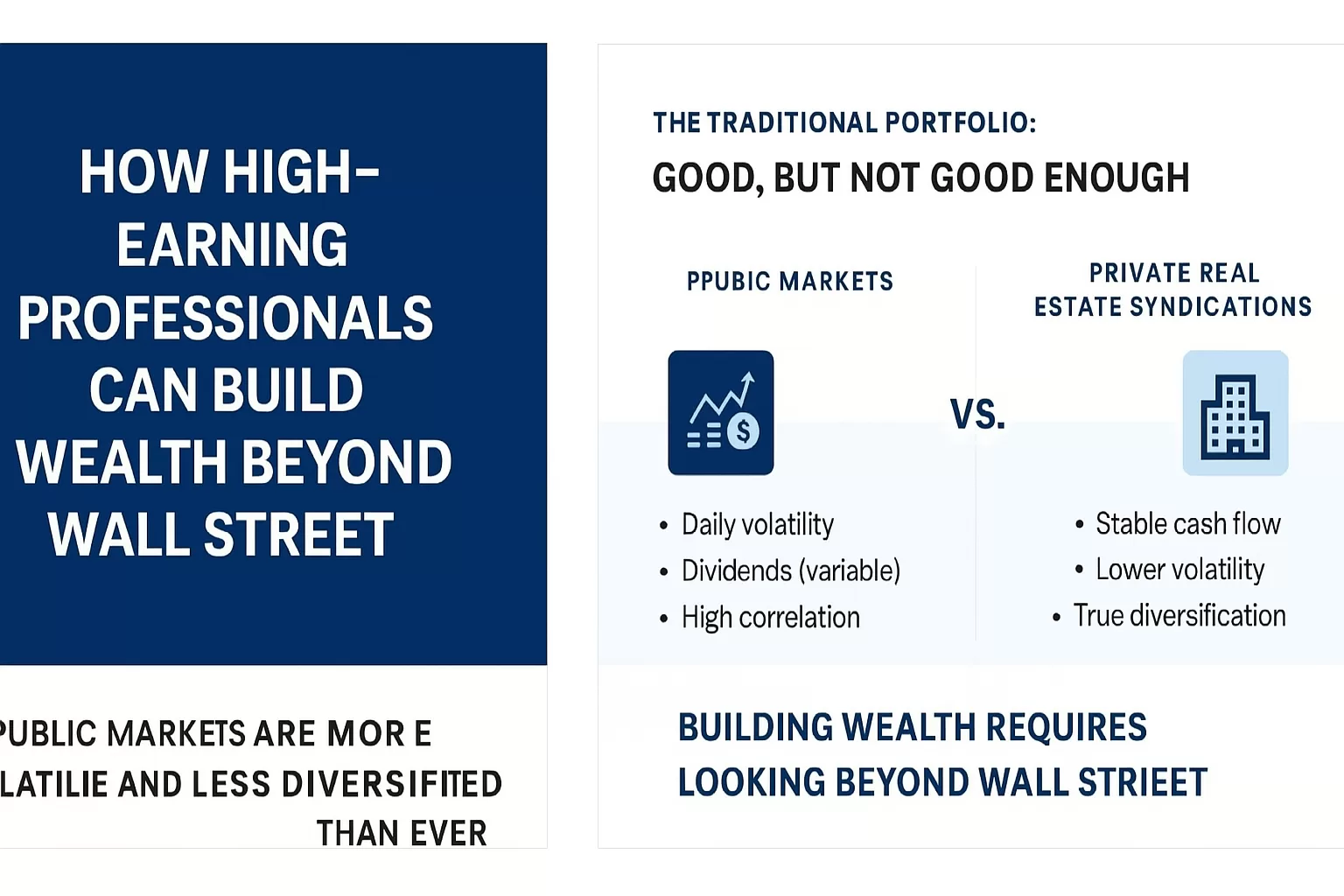
The Traditional Portfolio: Good, But Not Good Enough
For decades, the “60/40 portfolio” — 60% stocks, 40% bonds — was gospel. Stocks delivered growth. Bonds delivered safety. Together, they smoothed out the ride.
It worked for a while.
But today’s environment — with higher volatility, stubborn inflation, and uncertain interest rates — has exposed the cracks:
- Stocks are increasingly correlated across sectors.
- Bonds no longer guarantee real returns after inflation.
- Traditional diversification just isn’t diversified enough anymore.
If you’re serious about preserving and growing wealth, it’s time to add a third pillar: private real estate.
Why Private Real Estate is the Logical Next Step
Private real estate syndications — where multiple investors pool capital into a larger, professionally managed property — offer unique advantages that stocks and bonds alone can’t match:
- Stable Cash Flow:
Unlike public markets, income-producing properties generate predictable, contractual revenue streams. - Low Correlation with Wall Street:
Real estate doesn’t move in lockstep with the S&P 500. It acts as a ballast when public markets get turbulent. - Appreciation Potential:
Strategic improvements, rent growth, and market dynamics can drive real asset appreciation over time — not just inflationary gains. - Tax Efficiency:
Depreciation shields much of the cash flow from current taxes, and long-term capital gains treatment applies at exit.
In other words: real estate is tangible, cash-flowing, and historically resilient.
Public Volatility vs. Private Resilience
Here’s a blunt contrast:
| Public Markets | Private Real Estate Syndications | |
|---|---|---|
| Pricing | Daily volatility, emotional swings | Asset-based valuations, longer timeframes |
| Cash Flow | Dividends (variable) | Contractual rental income (predictable) |
| Liquidity | High | Low (5–10 year hold) |
| Volatility | High | Low to moderate |
| Tax Efficiency | Minimal | High (depreciation, 1031 exchanges, lower cap gains rates) |
Yes, you trade daily liquidity for greater stability.
But if you’re thinking like a long-term wealth builder — not a day trader — that’s a smart trade.
How the Best Portfolios Are Built Today
The new formula for serious wealth preservation and growth is no longer just 60/40.
It’s 60/30/10 — or some variation that carves out meaningful exposure to alternatives:
- 60% Stocks: Growth engine
- 30% Bonds/Cash: Stability and liquidity
- 10%–20% Private Real Estate & Alternatives: Inflation hedge, cash flow, and capital preservation
Sophisticated investors, university endowments, and family offices have followed this model for years. Now, access to syndicated real estate investments means professionals like you can, too.
The Bottom Line
Building wealth today requires moving beyond Wall Street — without abandoning it.
Private real estate syndications offer an essential third pillar: steady income, lower volatility, and true diversification.
Because real wealth isn’t built chasing returns.
It’s built by owning assets that work harder and smarter over time.
Would you also like a matching LinkedIn carousel for this article? It would make a perfect high-level visual contrast between Wall Street vs. Private Real Estate — very shareable. 📈🏛️
(And I can even suggest a short headline and caption to post with it if you want.)

Win Coleman, CCIM, is a graduate of East Carolina University where he received his bachelor’s degree in finance. He holds both North Carolina and South Carolina Real Estate Licenses and was awarded the prestigious CCIM (Certified Commercial Investment Member) designation in 2008.
Win served on the board of directors of The Triangle Apartment Association (TAA) where he co-chaired The Independent Rental Owner’s Council (IROC). He is a member of the International Council of Shopping Centers (ICSC), the Triangle Commercial Association of Realtors (TCAR) and the Raleigh Kiwanis Club.
While a specialist in site identification, evaluation and acquisition for investors and businesses, he also has extensive experience in brokerage, leasing, property management and investment sales.
Win assists in managing The Coleman Group, LLC, which owns a portfolio of investment properties, and he is a member of our acquisitions committee. He has lifelong experience and love for historic properties including the one he restored and where he resides in Historic Oakwood in Downtown Raleigh.